

The Seven-Step framework
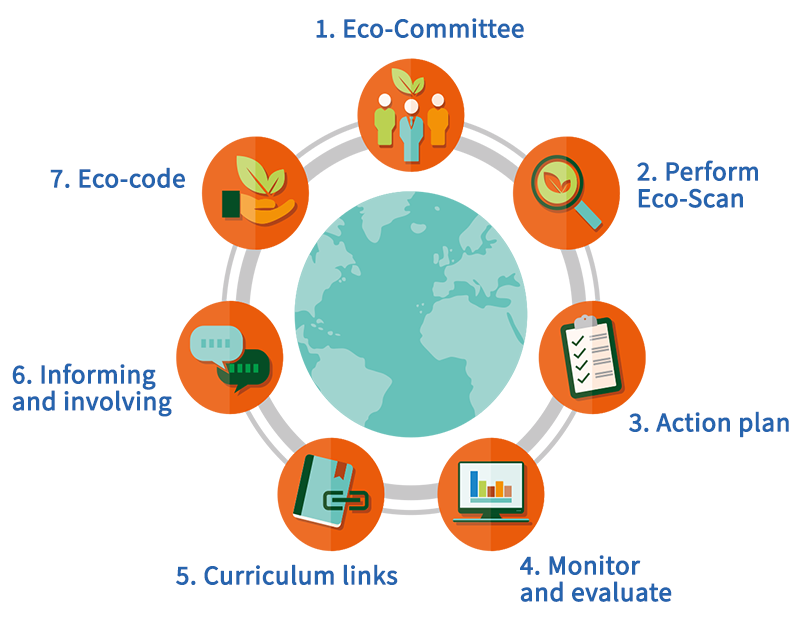
The Eco-Schools Seven-Step framework provides the Eco-Team with a clear and practical roadmap. At each step, you receive an instructional tool, tips and support from your own regional mentor. The steps are explained below.
Step 0. Statement of Intent
The school gets off to a celebratory start by having students, school leadership and, where appropriate, parents or other stakeholders sign a Statement of Intent. This demonstrates a shared commitment to working towards achieving the Green Flag.
Step 1. Eco-Committee
As a school, you appoint a coordinator for the Eco-Team. This could be a teacher, but it could also be a caretaker or teaching assistant, for example. The coordinator ensures that the Eco-Team meets regularly. The regional mentor coaches the Eco-Team throughout the process but does not attend every team meeting. At this stage, you start recruiting students to form an Eco-Team. The Eco-Team is a group of students who work to make their school more sustainable from within. Throughout the process, they develop important skills such as collaboration, communication and creative thinking. The composition of the Eco-Team will change somewhat each year as students move on to the next stage of their education.
Step 2. Perform Eco-Scan
Using the Eco-Scan, the Eco-Team assesses how sustainable the school is across ten different themes and identifies its strengths and areas for improvement. Based on the results, the team selects the themes they will focus on first.
Step 3. Action Plan
The Eco-Team develops an action plan with achievable goals and concrete actions for the selected sustainability themes. The actions focus on making education, the school environment and the behaviour of everyone within the school more sustainable.
Step 4. Monitor and evaluate
The Eco-Team regularly checks whether the actions are contributing to the agreed goals and adjusts them where necessary. By measuring and evaluating results, successes become visible and the team can identify areas for further improvement.
Step 5. Curriculum links
The school examines how sustainability is already incorporated into lessons and where this could be strengthened. Teachers play an important role in this process, while the Eco-Team remains involved in improving the place of sustainability within education.
Step 6. Inform and involve
The school makes its sustainability activities visible by informing and involving students, parents, teachers and other stakeholders. This increases awareness and strengthens the school’s sustainable identity and profile.
Step 7. Eco-code
The Eco-Team creates a creative Eco-Code that expresses the school’s sustainable identity and vision. This could take the form of a slogan, poster, song, video or work of art, for example.
The Sustainability Themes
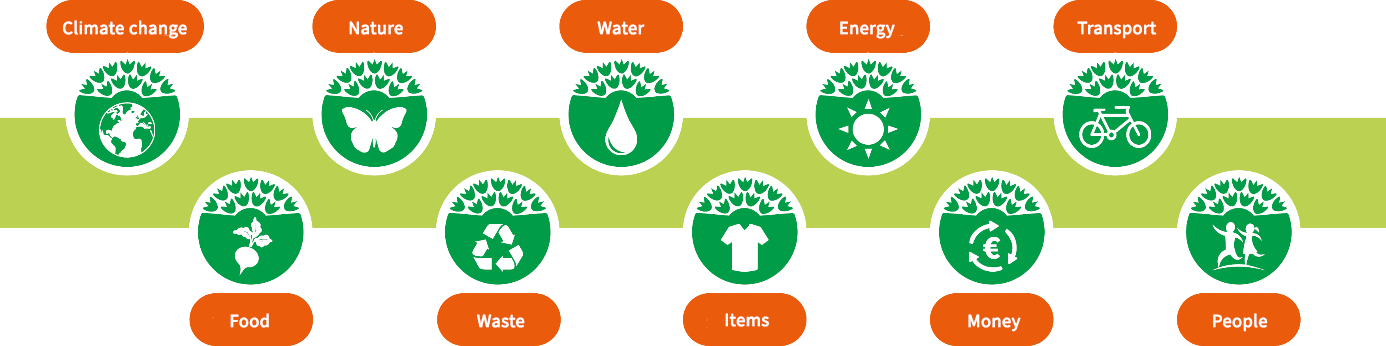
Eco-Schools focuses on ten different sustainability themes, covering both social and environmental aspects of sustainability. These themes also closely align with the 17 Sustainable Development Goals (SDGs). Using the Eco-Scan, the Eco-Team assesses the school’s performance across all ten themes. Based on the results of the scan and the interests of the students, the Eco-Team then selects two or three themes to focus on first. These selected themes form the foundation of the school’s action plan.
Audits and the Green Flag
Completing Steps 1 to 4 takes approximately one year. The school then shares its results and examples of its work, after which an auditor provides feedback and assesses whether the school qualifies for the Bronze Certificate. Steps 1, 2, 3 and 4 form an annual cycle of recruiting, measuring, planning and implementing, and evaluating, which the Eco-Team repeats each year. In the second year, the Eco-Team continues with Steps 5, 6 and 7. After completing Step 5, the school undergoes another assessment for the Silver Certificate.
Once all the steps have been completed, the school becomes eligible for the Green Flag, the international sustainability certification for schools. An auditor visits the school to assess its development and commitment. Achieving the Green Flag is celebrated with a special event, after which the school continues to develop and improve its sustainability efforts.